Short answer
In 2026 the median forest land transaction price in Latvia is 3,000 € per hectare (data through 6 August 2026, 1,291 transactions). Half of transactions happen in the range from 1,350 to 4,190 €/ha. For arable land in the same period the median is 4,591 €/ha. Since 2022 the median forest land price has not gone outside the 2,857–3,519 €/ha corridor.
Note: the publicly registered forest transaction price often is not the full amount paid — explained in section 5.
1. How the price has changed since 2022
The median forest land price has stayed within a narrow corridor over five years. The lowest median was in 2022 — 2,857 €/ha, the highest in 2023 — 3,519 €/ha. The difference between the lowest and highest year is 23%, and since 2024 the median has slid back down to around 3,000 €/ha.
For arable land the picture is different: the median grew for two years in a row — from 4,000 €/ha in 2022 to 4,965 €/ha in 2024 — and has since shrunk: 4,936 €/ha in 2025 and 4,591 €/ha in 2026.
Median transaction price, €/ha
Land transactions without buildings · 2026 through 6 August
Forest land (≥ 80% of area) Arable land (≥ 80% of area)
| Year | Forest, median | Forest, transactions | Arable land, median | Arable land, transactions |
|---|---|---|---|---|
| 2022 | 2,857 | 3,227 | 4,000 | 1,829 |
| 2023 | 3,519 | 2,760 | 4,498 | 1,620 |
| 2024 | 3,494 | 3,243 | 4,965 | 1,857 |
| 2025 | 2,950 | 2,833 | 4,936 | 1,557 |
| 2026* | 3,000 | 1,291 | 4,591 | 654 |
* 2026 is not a full year — the data covers the period through 6 August.
2. The median is misleading: the spread is huge
Naming a single figure for forest land is misleading, and this is clear in the spread. In 2026 the median is 3,000 €/ha, but the middle half of transactions falls between 1,350 and 4,190 €/ha — the upper bound is more than three times the lower one. A quarter of transactions happen below 1,350 €/ha, a quarter above 4,190 €/ha.
Practical meaning: if someone names a "forest price in Latvia" with a single number, that says nothing about a specific property. What matters is the stand's age, species composition, accessibility, encumbrances and location — and it is precisely these factors that create this spread.
Forest land price spread, €/ha
Band = the middle half of transactions (25th–75th percentile) · thick line = median
3. Forest vs. arable land
In all five years arable land has been more expensive than forest land. In 2026 the difference is 1,591 €/ha, or 53% — arable land 4,591 €/ha versus forest's 3,000 €/ha. The smallest difference was in 2023 (28%), the largest in 2025 (67%).
This comparison should not, however, be read as "forest is a worse investment". Arable land's price includes the full value, but a forest transaction's public price often does not include the value of the standing timber stock — see section 5.
4. Where forest is more expensive in Latvia
Comparing 2024–2026 transactions across 31 novads that had at least 40 forest transactions, the highest median price is in Ķekava novads — 4,545 €/ha, the lowest in Preiļi novads — 2,246 €/ha. The difference between the highest and lowest novads is twofold.
At the top of the list are the Pierīga novads, at the bottom Latgale. Why exactly that is — these figures don't say; checking the causes would require a separate analysis with control variables.
| Novads | Median, €/ha | Transactions |
|---|---|---|
| Ķekavas nov. | 4,545 | 52 |
| Ropažu nov. | 4,310 | 43 |
| Valkas nov. | 3,778 | 68 |
| Saulkrastu nov. | 3,627 | 42 |
| Saldus nov. | 3,513 | 110 |
| Siguldas nov. | 3,500 | 131 |
| Limbažu nov. | 3,447 | 390 |
| Cēsu nov. | 3,357 | 263 |
| Talsu nov. | 3,350 | 311 |
| Ogres nov. | 3,338 | 214 |
| Jelgavas nov. | 3,333 | 53 |
| Aizkraukles nov. | 3,300 | 222 |
| Smiltenes nov. | 3,300 | 176 |
| Kuldīgas nov. | 3,265 | 193 |
| Alūksnes nov. | 3,265 | 253 |
| Jēkabpils nov. | 3,250 | 419 |
| Madonas nov. | 3,226 | 339 |
| Ventspils nov. | 3,178 | 109 |
| Bauskas nov. | 3,174 | 204 |
| Dobeles nov. | 3,159 | 88 |
| Ludzas nov. | 3,115 | 358 |
| Dienvidkurzemes nov. | 3,102 | 196 |
| Gulbenes nov. | 3,077 | 215 |
| Balvu nov. | 3,066 | 393 |
| Valmieras nov. | 3,017 | 343 |
| Tukuma nov. | 3,014 | 191 |
| Rēzeknes nov. | 3,000 | 587 |
| Līvānu nov. | 2,958 | 88 |
| Krāslavas nov. | 2,936 | 567 |
| Augšdaugavas nov. | 2,512 | 352 |
| Preiļu nov. | 2,246 | 313 |
The table includes all 31 novads that had at least 40 forest transactions in 2024–2026 (a total of 7,283 transactions). Novads with fewer transactions are not compared because the median becomes unstable. The location of each individual transaction can be viewed on the KALME map.
5. Why the public price isn't the full price
Important about forest transactions. In Latvia, forest sellers and buyers tend to sign two separate contracts — one for the real estate, another for the timber stock. Only the property contract is publicly registered, so the registered price can be lower than the amount actually paid.
This applies to all public forest price sources, including this article. The figures below are accurate in the sense that they reflect what was registered, but the registered and the paid amount do not always match in forest transactions.
One possible explanation for why the forest median is lower than for arable land is precisely these split contracts: this phenomenon does not exist for arable land transactions, because there the whole value is in a single contract. Whether that explains the entire difference cannot be determined from this data alone.
6. Methodology — how these figures are calculated
The figures are reproducible. For anyone who wants to check or cite them, here are the exact definitions.
- Source: the State Land Service's Real Estate Market Database (NĪTIS), public transaction data.
- Data volume: the KALME database holds 251,015 unique transactions, of which 240,170 since 2022. The data covers the period through 6 August 2026.
- Duplicates: one transaction in the source can appear in several rows (for example, several parcels in one contract). Each transaction is counted once, by its transaction identifier.
- Forest land: a land transaction without buildings, where forest land makes up at least 80% of the sold area. The 80% threshold is the same one used by the KALME map filter "Forest only", but here it is calculated from the areas declared in the transaction, whereas the map filter uses the cadastral land composition. So the two selections are not identical.
- Arable land: the same, but arable land makes up at least 80% of the sold area.
- Area threshold: at least 1 ha. Smaller plots produce extreme €/ha values and distort the distribution.
- Price per hectare: the transaction amount divided by the sold area (not the whole property's area). If an ideal share was sold, the area is already reduced accordingly.
- Trimming: only values strictly within the interval 100 < price < 50,000 €/ha are included; the rest are discarded as obvious data errors or atypical transactions (gifts, transactions between related parties).
- Statistic: the median, not the arithmetic mean — the median is not distorted by a few very expensive transactions.
- Summary: the forest sample has 13,354 transactions, 114,584 ha, median sold area 5.5 ha. The arable land sample has 7,517 transactions.
This article contains no estimated, modelled or forecast figure. Everything is measured from registered transactions. Personal data is not published.
7. Frequently asked questions
How much does forest land cost per hectare in Latvia?
In 2026 (data through 6 August) the median price is 3,000 €/ha, and half of transactions happen in the range 1,350–4,190 €/ha. The calculation is based on 1,291 real transactions.
Are these figures a price forecast for my property?
No. They are a summary of registered transactions. The price of a specific property is set by the stand's age, species composition, accessibility and encumbrances. KALME does not value properties — we show what has really sold for nearby, and the user draws the conclusion.
Why do these figures differ from forest price calculators?
Calculators usually show an estimate, this article — registered transactions. The difference is also caused by split contracts (section 5), and by the fact that a calculator usually values the forest together with the timber stock, while the public transaction — not always.
How often are these figures updated?
The KALME transaction database is updated every month. This article will be recalculated once a year; the latest recalculation is noted at the start of the article, next to the date.
Sources and licenses
- Transaction data: Real Estate Market Database (NĪTIS), © State Land Service of Latvia, open data. Processing: KALME, SIA.
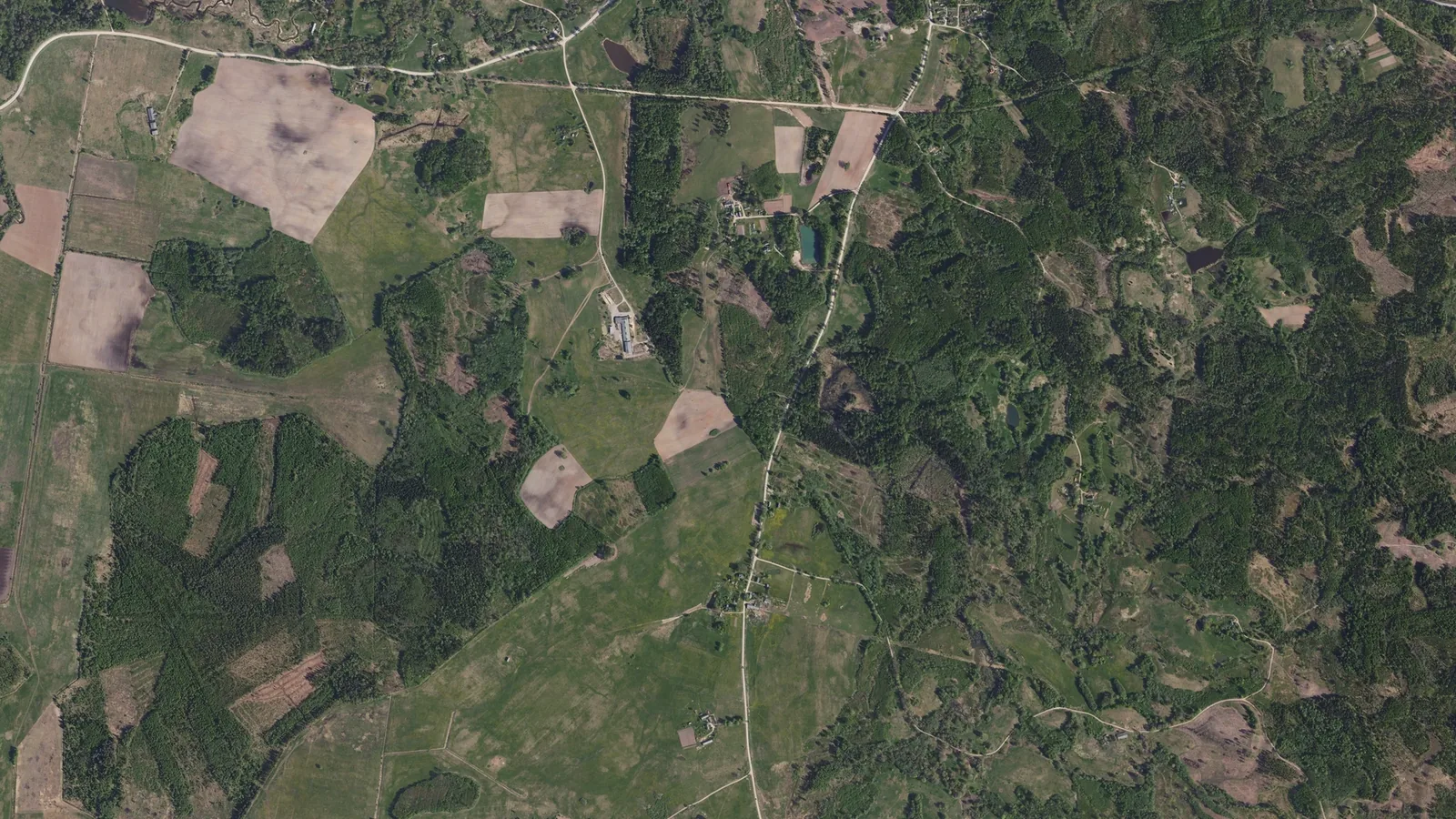
- Orthophoto: © Latvian Geospatial Information Agency, 2024. Image prepared from LĢIA orthophoto coverage.
- Calculations by KALME, SIA (reg. No. 43603092426). Questions and corrections: [email protected].